


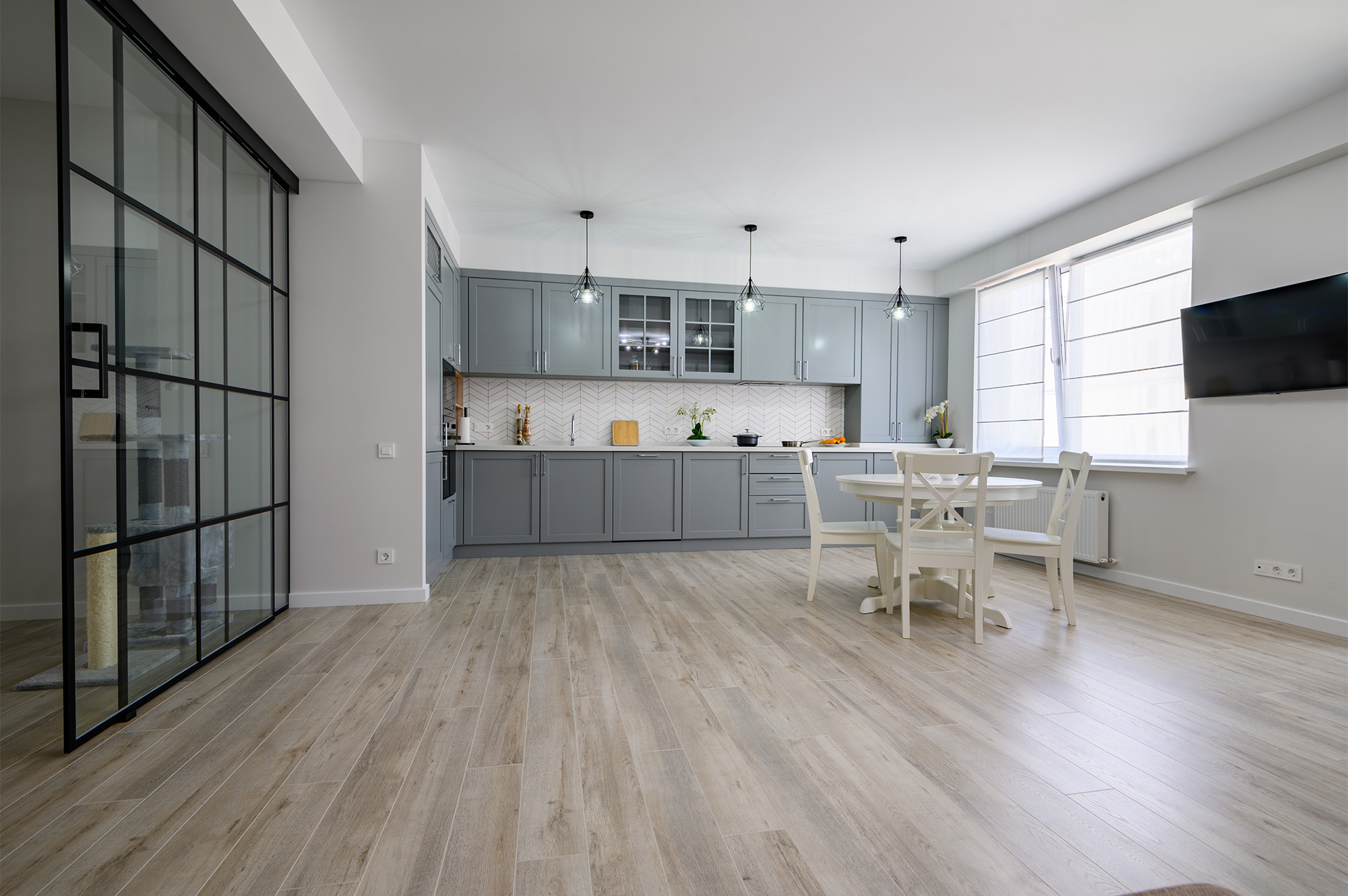
When homeowners in Louisville’s flood-prone areas select luxury vinyl plank (LVP), they’re expecting waterproof performance—not surprise mold blooms. Yet one of the most overlooked installation risks comes from what’s underneath: vinyl installed directly over OSB (Oriented Strand Board). At Pontrich Floor & Paint, with showrooms across @@all-showrooms@@, we regularly inspect failed installations where moisture-sensitive OSB compromises even the highest-quality vinyl.
What makes OSB risky in Louisville specifically?
Louisville’s Ohio River valley climate produces repeated wet–dry cycling, high ambient humidity, frequent basement moisture issues, and—most importantly—groundwater pressure after heavy rains. In flood-prone ZIP codes like 40216, 40258, and 40272, slab-on-grade homes and crawlspaces often experience moisture migration that OSB is not engineered to handle consistently.
Understanding the OSB–Vinyl Moisture Interaction
Vinyl itself is waterproof. OSB is not. Unlike plywood, OSB absorbs moisture slowly but deeply, swelling in thickness and breaking down internal resins. When vinyl is installed directly over OSB:
Moisture becomes trapped under the vinyl layer, unable to evaporate upward.
The OSB remains wet for longer periods, accelerating fungal growth.
Vinyl’s tight locking systems prevent airflow, creating a “moisture lid.”
This is why homeowners often see:
• cupping or peaking in planks
• soft or “spongy” spots forming
• dark discoloration along seams
• musty odors after seasonal rain
Why Louisville’s Climate Makes This Worse
Louisville’s year-round relative humidity averages above 70%, and crawlspace vents allow ambient moisture to intrude.
Additionally:
Clay-heavy Jefferson County soils slow drainage, prolonging subfloor dampness.
Older homes lack vapor barriers beneath OSB.
Basement seepage can raise moisture from the slab straight into subfloor panels.
The result? Even “moderate” moisture conditions in Louisville behave like high-risk conditions in other regions.
Mitigation Strategies Recommended by Pontrich Floor & Paint
To prevent mold growth and subfloor collapse beneath vinyl installations, our experts recommend:
1. Mandatory Moisture Testing
ASTM F2170 in-slab RH testing and ASTM F2659 surface moisture meters ensure OSB is below safe thresholds. Anything above 12–14% moisture content is a red flag.
2. Install a Proper Vapor Barrier
A 6–10 mil polyethylene vapor barrier beneath the OSB (if accessible) or directly over the OSB (before underlayment) dramatically reduces vapor diffusion.
3. Consider Plywood Upgrades
In flood-sensitive areas, switching from OSB to tongue-and-groove plywood provides:
faster drying
better long-term dimensional stability
reduced fungal risk
4. Use Flood-Zone-Rated Underlayments
Not all underlayments are equal. Seek ones with:
antimicrobial coatings
integrated vapor retarders
hydrophobic foam layers
5. Don’t Skip Perimeter Expansion Gaps
Tight installations increase plank compression as OSB swells. Proper spacing ensures movement doesn’t telegraph into the vinyl surface.
Final Thoughts
Vinyl is waterproof—but a system is only as reliable as its subfloor. In Louisville’s moisture-active regions, homeowners must assume OSB will encounter humidity, seepage, or even minor flooding during its lifespan. Pontrich Floor & Paint helps customers select the right prep solutions so their flooring lasts.
To protect your investment, visit us at @@all-showrooms@@ or contact today. We proudly serve @@service-areas@@.


